
2 Nov 2026
Sand and salt spreader lighting
A salt and sand spreader is a specialised piece of municipal equipment that operates in an extremely harsh physicochemical environment during winter road maintenance. If you are responsible for a winter road maintenance fleet, you know perfectly well that heavy snowfall, sub-zero temperatures and pervasive salt brine put every electrical component to the ultimate test. Lighting installed on this type of equipment cannot be a matter of chance or a budget-driven compromise. Aggressive salt spray discharged by the spreading disc can quickly penetrate inadequately sealed housings, causing short circuits and costly equipment downtime in the middle of a snowstorm. By investing in uncompromising LED lighting systems, you can ensure uninterrupted operation while helping to protect the safety of both the operator and other road users.
Why does professional lighting for municipal vehicles require a high IP68 protection rating?
Winter operating conditions present optoelectronic components with challenges unlike those encountered in any other transport sector. When choosing lighting for municipal vehicles, you should pay particular attention to the ingress protection rating and the chemical resistance of the materials used in their construction. Standard lamps quickly become cloudy, while their electrical contacts corrode when exposed to sodium chloride and calcium chloride. At HORPOL, we use hermetically sealed housings with an IP68 protection rating, ensuring complete dust-tightness and full resistance to hot-water pressure washing. Polycarbonate lenses offer excellent impact resistance, allowing them to withstand impacts from small aggregate particles, while aluminium heat sinks efficiently dissipate heat generated by the LEDs, protecting the electronics against overheating.
The development of such solutions is based on many years of engineering experience and the continuous improvement of manufacturing technologies. HORPOL has been operating continuously since 1979, building its reputation as a Polish expert in lighting technology, with entirely Polish ownership and local manufacturing facilities. At our factory in Lipniki, we have our own design and engineering department, as well as an in-house photometric laboratory equipped with goniophotometers, integrating spheres and spectroradiometers. Every new lamp undergoes rigorous testing designed to simulate years of exposure to moisture, vibration and extreme temperatures. As a result, you get lighting equipment that can easily withstand even the harshest winter conditions on city streets and motorways.
Sand and salt spreader lighting for tractors operating in challenging terrain
In urban and suburban environments, tractor-mounted sand and salt spreaders often operate on narrow pavements, residential pathways and local roads. These compact setups have limited dimensions but require particularly effective lighting and signalling due to their proximity to pedestrians and parked vehicles. Rear-mounted tractor equipment can obscure the original lights of the base machine, making it essential to duplicate the position lights, brake lights and direction indicators on the spreader’s frame itself. Compact combination lamps are an excellent choice for this application. Examples include the Cleo series (LZD 2790) and Roca series (LZD 2800), which provide a complete set of signalling functions while requiring minimal mounting space.
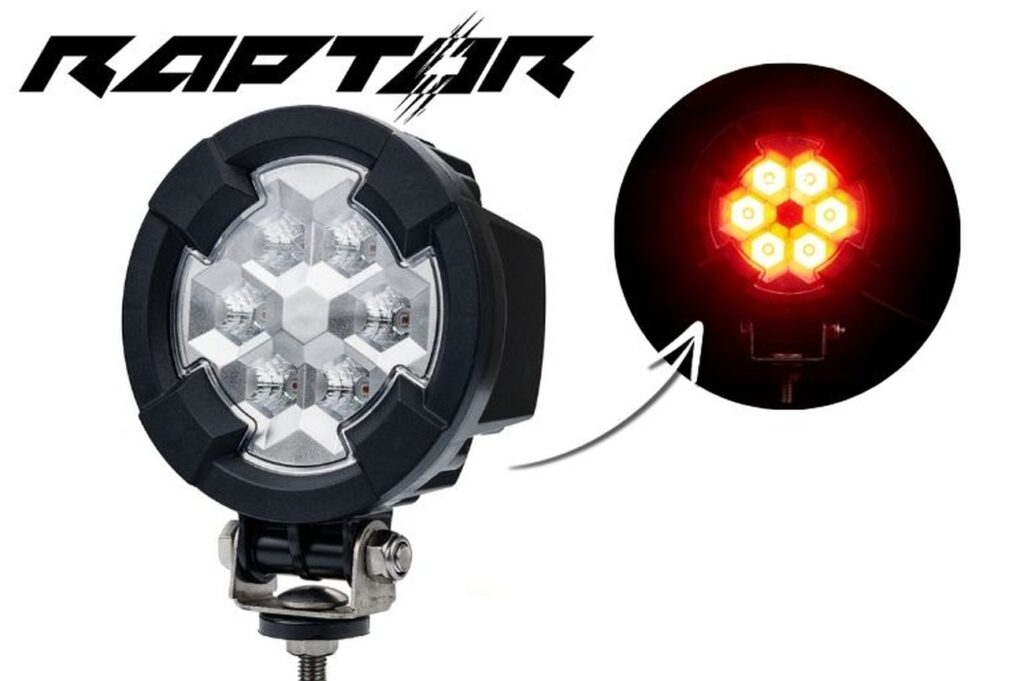
Equally important is illuminating the discharge area for the abrasive material, allowing you to monitor the width and evenness of salt distribution in real time, directly from the tractor cab. For this purpose, specialised red-light work lamps are an excellent choice, designed specifically for operation in clouds of snow and swirling ice. A great option is the compact Raptor LRD 3188 work lamp, delivering 650 lm, or the proven LRD 2679 RED model. Both provide illumination without creating distracting glare on icy, reflective surfaces. The red beam stands out clearly against the snow, allowing you to easily monitor the spreading disc’s operation without straining your eyes during night shifts. The safety of the entire vehicle combination can be further enhanced by installing flexible marker lamps on stalks from the Dragon series, such as the LD 3171 model. Their flexible stalks bend freely when they come into contact with snowdrifts, helping prevent mechanical damage.

Certified flashing beacons and lighting for special-purpose vehicles
From a legal and technical perspective, winter road maintenance vehicles fall under the category of special-purpose vehicles and must fully comply with the requirements of ECE R65 regulations. Intense amber warning signals serve as a crucial alert to other drivers, prompting them to exercise extra caution in challenging winter conditions. A salt spreader needs high-intensity warning beacons that remain visible from hundreds of metres away, even through clouds of airborne snow. At HORPOL, you will find advanced LED warning beacons from the LDO 2274 series and LDO 2276. They feature various rotating and strobe flash patterns and are resistant to vibrations generated by hydraulic motors and conveyor belt operation.
If your vehicles frequently switch between different equipment configurations, portable warning beacons with magnetic bases and coiled cables are an excellent alternative. Examples include the LDO 2275 and LDO 2664/F. HORPOL’s integrated electronic systems are EMC R10 certified, ensuring electromagnetic compatibility and preventing interference with CB radios, GPS terminals and the tractor’s CAN bus system. Wide-voltage converters (12/24 V) ensure stable LED operation even during significant voltage fluctuations caused by switching high-power electrical equipment, such as heated windows or hydraulic pumps. This means you can rely on your lighting to operate consistently, regardless of the load on the vehicle’s electrical system.
Illuminating the work area – how do HORPOL work lamps improve spreading precision?
A properly selected salt and sand spreader must give you excellent control over the spreading width, ensuring that valuable de-icing material does not end up in roadside ditches. Standard white lighting often proves ineffective when operating a salt spreader, as it can create an overwhelming wall of glare and reflect off swirling ice crystals. For this reason, dedicated red-light work lamps are the best choice for illuminating the discharge area. Recommended options include the Raptor LRD 3188, featuring a flood beam, and the LRD 2679 RED. Red light provides excellent contrast against snow-covered surfaces, reduces back-glare and allows the operator to control the distribution of abrasive material with precision, even during long hours of continuous operation. Discover how professional HORPOL work lamps can improve the efficiency of your municipal equipment and explore our full range of specialist lighting solutions.
A practical solution for simplifying the installation on salt spreaders is to use multifunctional lamps that combine work lighting with an integrated warning module, such as models from the LRD 3043/BL/A1/4K range. By mounting a single lamp on the corner of the spreader’s body, you can illuminate the manoeuvring area while also providing an intense warning strobe to alert approaching vehicles. For inspecting the inside of the hopper, sealed interior lighting lamps are an excellent choice. Examples include the LWD 2154 and LWD 2758 with aluminium housings. They make it easier for operators to inspect the condition of the sieve and check the fill level of the spreading material, even in complete darkness. The durable lens construction protects the light source against accidental impacts from a shovel or frozen lumps of salt when refilling the hopper.
Winter maintenance of electrical systems
The key to ensuring reliable operation throughout the winter season is daily preventive maintenance after returning to the depot. Wash accumulated salt deposits from lamp housings and lenses using clean water, avoiding harsh solvents that could damage the polycarbonate coating. Once a week, check the condition of cable glands, ensure that stainless steel mounting screws are properly tightened, and inspect the permeability membranes that prevent moisture condensation inside the lamps during sudden temperature fluctuations. Taking simple steps to keep lighting surfaces clean ensures maximum light output and extends the service life of your equipment for many winter seasons to come.
